NEW YORK — The S&P/TSX Global Mining Index (TSX:TXGM) is approaching the 261 level, reflecting a pronounced multi-year advance punctuated by significant volatility, according to a recent TradingView weekly chart snapshot. From a low near 40 in early 2016 to the recent zone around 260, the index—tracking a broad basket of mining equities—has demonstrated a more than sixfold climb over roughly a decade. This rise unfolds amid considerable swings in the 200-280 range in recent months, underscoring the sector’s sensitivity to fluctuating global economic conditions and shifting institutional capital flows. Notably, the index is distinct from the TSX Venture Composite, which predominantly covers smaller, early-stage miners, and instead represents a more established mining equity cohort, with constituents ranging widely across metals and mining subsectors.
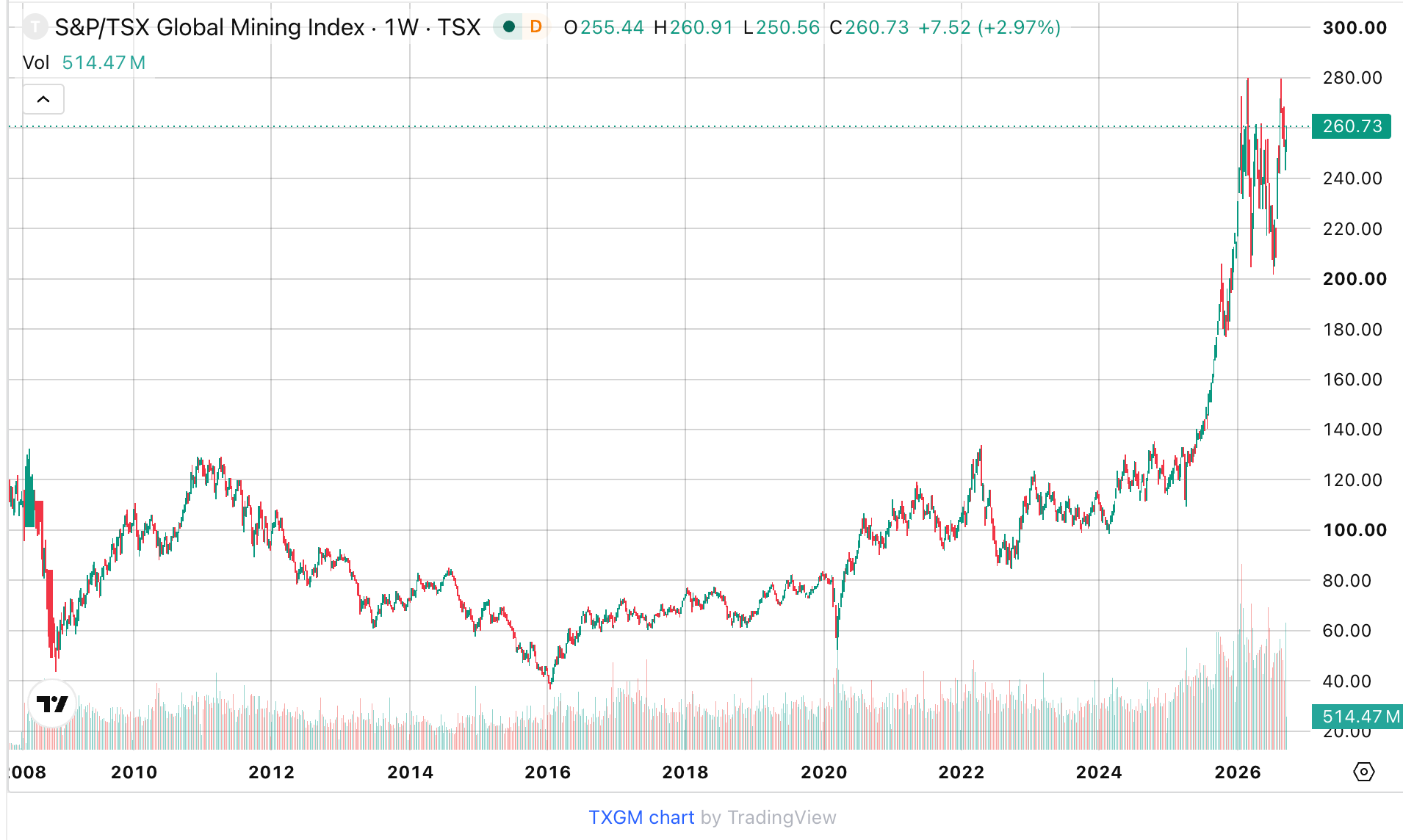
Image Source: TradingView
The index’s trajectory from its mid-2010s lows through the pandemic-induced decline around 2020, followed by a protracted recovery back to the 100–130 area and then accelerated gains during 2025 into 2026, encapsulates the evolving investment landscape for mining companies. This performance coincides with broader macroeconomic transitions, including tightening commodity supply amid decarbonization efforts, geopolitical supply chain reconfigurations, and the increasing emphasis on battery metals and critical minerals. Investors appear to be reallocating portfolios toward mining equities as strategic plays in resource security and inflation hedging, resulting in notable shifts in market positioning reflected in heightened volume and price swings observed in the index’s recent sessions.
The index’s current level around 260, as observed from the weekly open at approximately 255.44, high to 260.91, low near 250.56, and a close around 260.73 with significant 514 million in volume, points to robust trading interest. However, such volatility signals a market in flux, grappling with the juxtaposition of strong sector fundamentals and macroeconomic uncertainties—particularly inflationary pressures, interest rate trajectories, and demand patterns in China and other emerging markets. While the upward trend evidences confidence in mid-to-large cap mining firms’ ability to generate free cash flow amid rising commodity prices, the fluctuations highlight caution among institutional investors balancing exposure to cyclical metals with broader portfolio risk.
Among key companies influencing this sector-wide narrative are giants such as Teck Resources Ltd. (TSX:TECK), which benefits from diversified base metals exposure; Barrick Gold Corporation (TSX:ABX), a bellwether in precious metals with operational resilience; and Nutrien Ltd. (TSX:NTR), whose fertilizer products link mining with agricultural demand cycles. Collectively, these corporates illustrate the cross-sector linkages between mining equities and broader industrial and consumer demand trends. Their stock movements often serve as proxies for investor sentiment on resource supply constraints and inflation hedging, thereby affecting capital flows within the S&P/TSX Global Mining Index framework.
The dynamic positioning of institutional investors within TSX:TXGM constituents reflects ongoing recalibrations to global supply chain disruptions, energy transition imperatives, and the geopolitical recalibration of resource dependencies. Increased allocation toward miners with advanced critical minerals projects for electric vehicle batteries and renewable energy infrastructure may underpin recent index strength, while profit-taking and tactical reallocations drive observed volatility. Meanwhile, heightened trading volumes underscore sustained liquidity, enabling portfolio managers to pivot amid fast-changing macroeconomic signals without excessive market impact.
Going forward, the S&P/TSX Global Mining Index’s trajectory will likely serve as a barometer for broader commodity market sentiment and institutional appetite for resource equities amidst a complex global growth outlook. Investors monitoring TSX:TXGM should consider that ongoing volatility and near-peak levels reflect an active repositioning phase rather than a steady-state trend. Macroeconomic developments—especially inflation dynamics, interest rate policies, and geopolitical shifts—will remain critical in influencing flows and valuations. In this context, mining equities continue to provide both opportunities and risks as essential components of diversified strategies aiming to capture long-term structural shifts in resource demand against a backdrop of macroeconomic and sector-specific uncertainty.
Sources consulted for this analysis include the publicly available S&P Dow Jones Indices methodology (https://www.spglobal.com/spdji/zh/documents/methodologies/methodology-sp-tsx-global-mining.pdf) and TMX Money index quotes (https://money.tmx.com/en/quote/TXGM). All numerical chart observations derive from a TradingView weekly timeframe screenshot as shared, reflecting recent weekly bar data without independent price verification.
Spotrate NewsDesk